

Simple steps to save newborns
Publié il y a 4 mois
08.07.2026
Partager
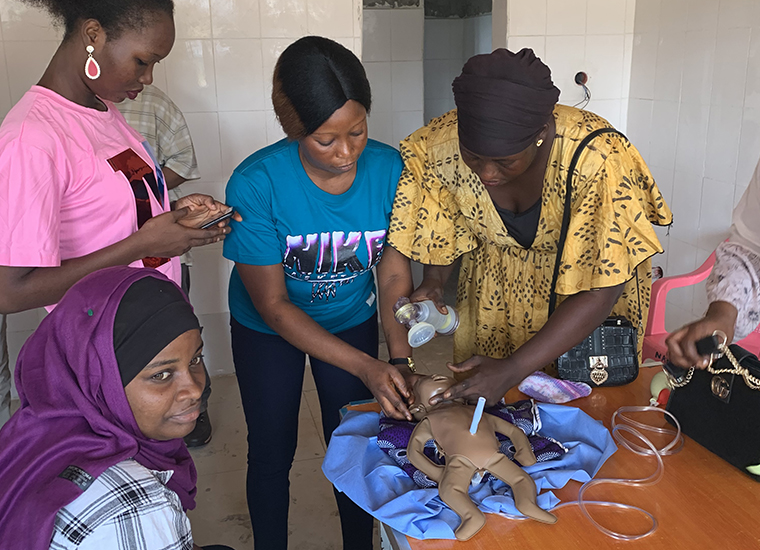
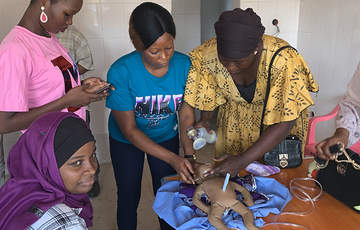
Neonatal mortality, occurring in the first four weeks of life, is the third leading cause of death in Guinea among all age groups. Its main causes are prematurity, infections and asphyxia. The team at the Souffle2Vie association is committed to reducing oxygen-related deaths among newborns in Guinea. This Swiss non-profit organisation has carried out around 20 on-site missions over 10 years. Its latest published study on the subject speaks for itself. As a result of one of their many training sessions on newborn resuscitation, the mortality rate within six hours of delivery dropped from 32% to 6%. Training is organised over two days; the morning of the first day is devoted to theory, and the rest of the time to practice. “We address all the stages of childbirth that involve risks of asphyxia, and above all, how to deal with them through various simple techniques. Equipment such as a ventilation bag and the ‘penguin’, a bulb to clear the airways, is also available,” explains Céline Lomme, a clinical nurse specialist at the CHUV and a member of the association.
The techniques taught are designed to initiate spontaneous breathing. Once born, the baby is dried and stimulated by rubbing the back and the soles of the feet to trigger breathing. The newborn is then placed on its back, with a small piece of fabric under its shoulders to support the head in a neutral position, neither flexed nor extended, to open the airways.
In the event of absent or inadequate breathing, every second counts; the newborn risks asphyxia and significant neurological consequences. This is where the penguin and the ventilation bag come in. The first is a bulb syringe with a beak-like tip reminiscent of an Arctic bird's, used to aspirate any liquids that might block the airways. The ventilation bag, which delivers air directly into the newborn's lungs through the mouth, can then be used. "These missions show that with basic procedures and simple equipment, it is possible to achieve clear improvements," explains Matthias Roth-Kleiner, medical director of the CHUV and founder and president of Souffle2vie.
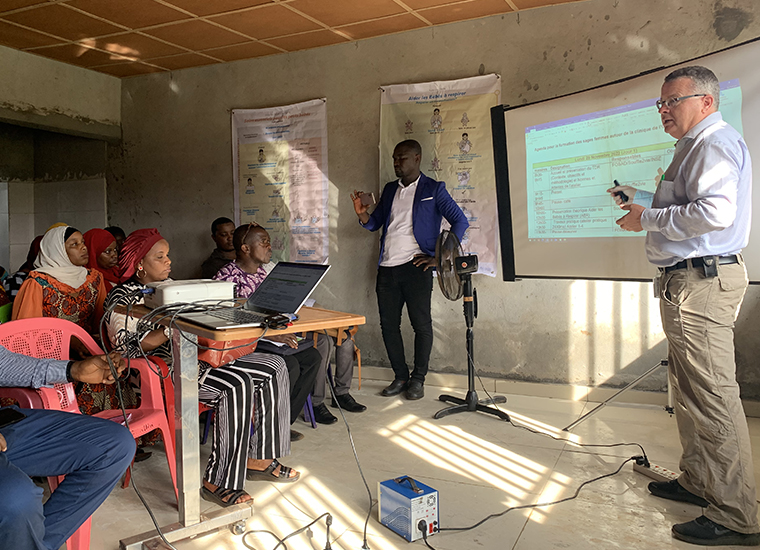
Globally, it is estimated that ten out of every hundred newborns will need assistance to start breathing. For nine of them, simple interventions as described above will suffice, while only one will need intensive care. "The training we offer in Guinea is designed to enable midwives to manage situations where a simple intervention is required," says neonatal physician Roth-Kleiner.
“To effectively reduce the number of deaths, we need to intervene everywhere, not only in hospitals,” explains the founder of Souffle2vie. After several missions in the public sector, including at the University Hospital of Conakry, the capital of Guinea, which handles around 6,000 births per year, this new mission targeted the private sector. According to the WHO and UNICEF, nearly half of all births in Guinea are attended by no health professionals. Many midwives work in the private sector without state-recognised training.
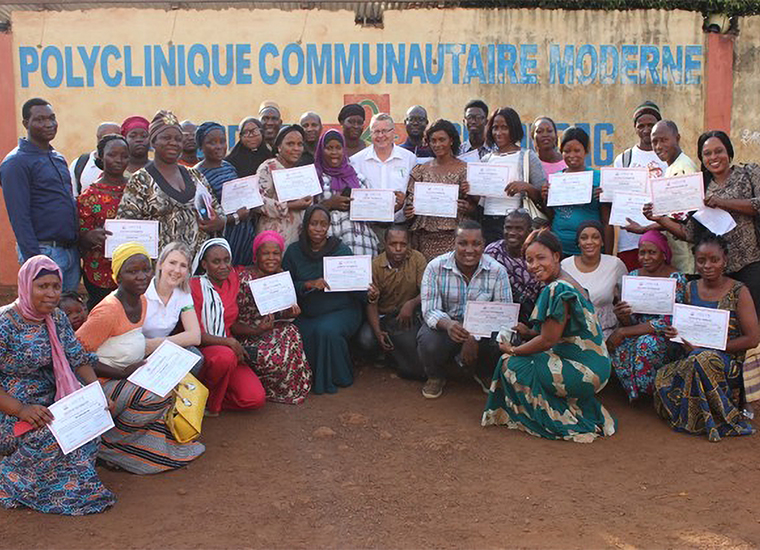
This recent training, delivered by Céline Lomme, Professor Roth-Kleiner, and the Guinean teams, has trained about fifty people, with particular attention to pedagogy, interdisciplinary collaboration, and joint development. The theoretical presentation is interactive, with answers to participants' questions provided by local doctors or by Souffle2vie. Practical workshops are delivered jointly, with supervision rotating between members of both teams. “We do not want to impose our methods. Our training courses are always developed with local medical staff to be as suitable as possible. We arrive with ideas and provide the equipment thanks to our donors, but it is then up to the professionals on site to take over. The aim is to train future trainers.”
These missions have a significant impact on newborn survival in Guinea, but they also resonate back home. “At the end of the day, the goal of a doctor is to save lives, and this kind of project enables very concrete action in this direction, which is extremely rewarding. Seeing the satisfaction of our Guinean colleagues as they take ownership of these methods is also very encouraging," says Matthias Roth-Kleiner.