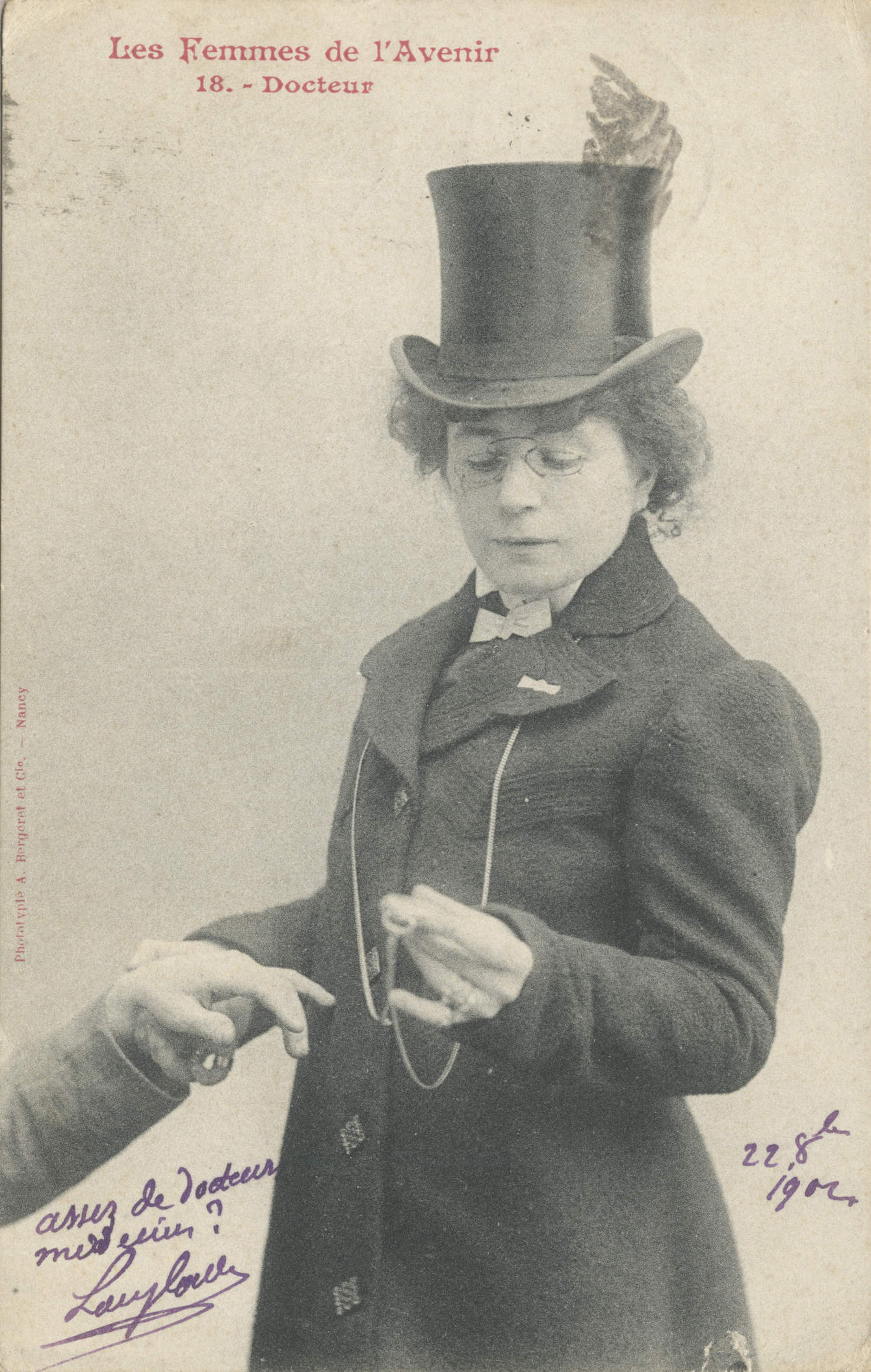

Understanding what the first women doctors collectively brought to the theories and practices of medicine of their time, and making these pioneers and their work visible, is the ambition of the Medif project. Titled Female Medicine: A History of the First Women Doctors and Their Contribution to Medical Innovation between French-speaking Switzerland and France, 1867–1939, the project began last September at the Institute of Humanities in Medicine.
The first women doctors were trained almost exclusively in France or Switzerland, the only countries in Western Europe that widely opened their doors to female medical students from 1867. However, women encountered many obstacles along the way. For example, those who practised until the interwar period were, in their colleagues' eyes, competitors stealing their positions and patients. As a result, they had to organise themselves collectively and form networks composed mainly of researchers, such as the one studying sexuality funded by Marie Bonaparte. This group, whose work will be studied by the Medif project, sought to make women’s vision of their own bodies and sexuality visible. This example embodies the "female medicine" project, developed and disseminated by these women doctors from France and Switzerland, an initiative whose meaning and scope have not yet been studied. The analysis of the health manuals written by these women, tools for the development and dissemination of "female medicine", will allow us to reconstruct the scope of the project developed by these pioneers.
Lifting the veil on the first women doctors will allow us to retrace exemplary female careers. "But more than individual figures, it is the collective thought of these pioneers that will be highlighted through a mapping of their networks," explains the medical historian Amélie Puche. In addition, Medif will seek to understand why and how the role of these women remains unknown. An analysis of the mechanisms of invisibilisation at work, affecting both the personalities (and even the names) of these doctors and their work, will then be undertaken.
This research project, funded for four years by the Swiss National Science Foundation, is led by two co-presidents, Aude Fauvel and Rémy Amouroux, a postdoctoral student, Amélie Puche, and two PhD students, Alix Vogel and Mikhaël Moreau; it also involves two partners, Joëlle Schwarz (Unisanté) and Aurélien Ruellet (University of Le Mans).