


LAUGHING GAS, SERIOUS RISKS
Publié il y a 6 mois
18.09.2025
Partager
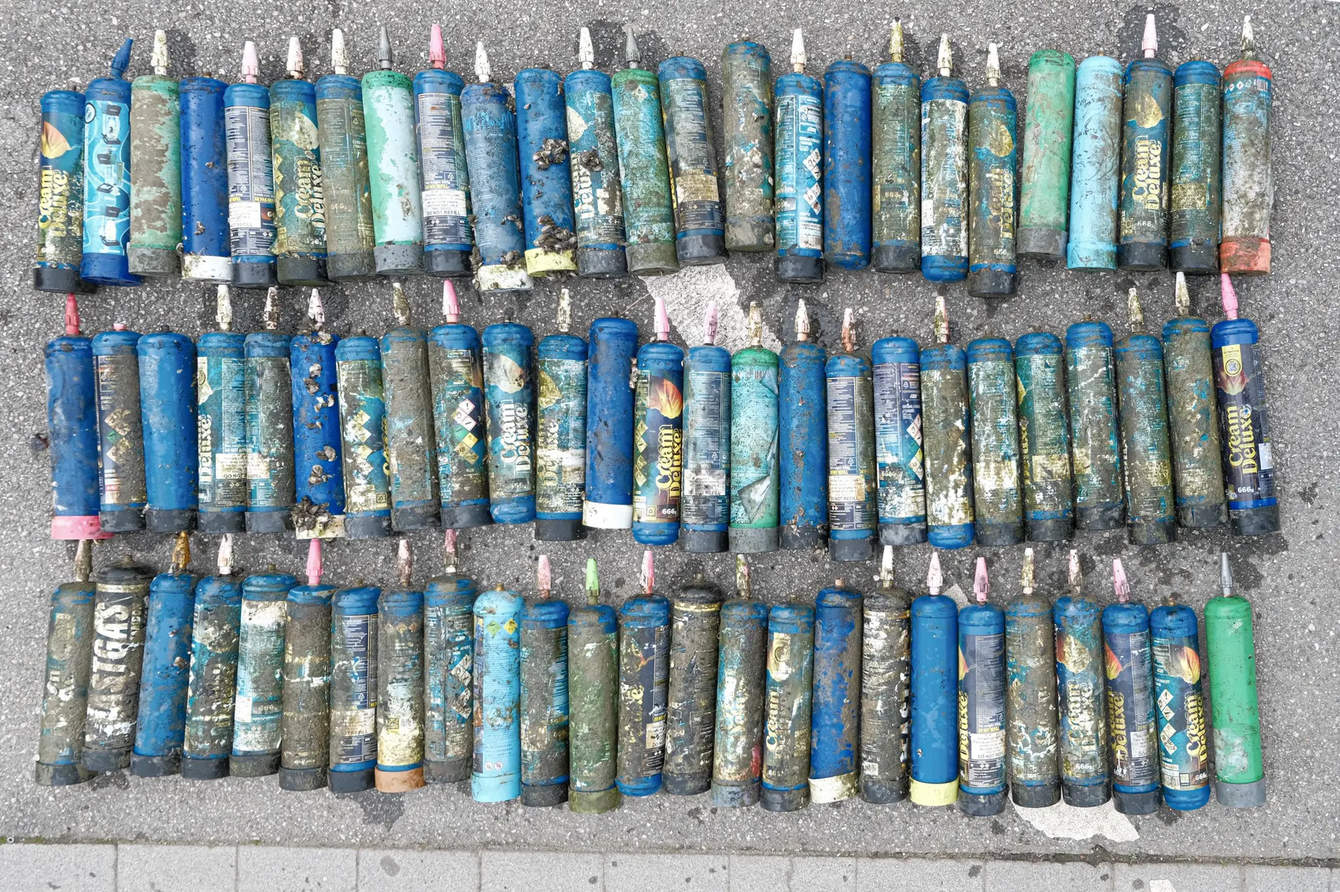
Last summer, off the coast of Cologny (GE), volunteers of a cleaning operation on Lake Geneva fished out something you don’t see every day: dozens of large nitrogen oxide cylinders. "After a diving exercise, the police alerted us to a significant amount of waste at that location," says Pascal Mulattieri, president of the Lake Geneva Conservation Society, which organises a seabed and shoreline cleanup of Lake Geneva every two years.
The ASL decided to set up a rapid-response operation, mobilising about thirty divers. “In total, we recovered nearly 80 canisters. In 2022, the team of volunteers in charge of this sector had already recovered about twenty large metal cylinders.”
Neurological disorders
Identified in the late 18th century by an English chemist, nitrous oxide is used as an anaesthetic in medicine. It is also used in the food industry, for example, as a propellant in whipped cream dispensers. Inhaling it causes a brief sensation of euphoria and disconnection, hence its name 'laughing gas'. But its misuse is far from harmless: when used repeatedly, “NOS” can lead to serious neurological disorders.
"Nitrous oxide is toxic because it inactivates vitamin B12 and certain metabolic reactions that are essential in the functioning of the nervous system," explains Marie Théaudin, assistant doctor and head of the Nerve-Muscle Unit within the Neurology Service of the CHUV. Vitamin B12 plays a crucial role in the formation of the myelin sheath, which protects the nerves. “The alteration of myelin can lead to dysfunctions of the central nervous system (spinal cord in the first place, and more rarely the brain) and peripheral nervous system (nerves in the arms and legs) responsible for sensory disorders, loss of coordination, muscle weakness, and even paralysis.”

“The more you consume, the greater the risk of complications”, says Marie Théaudin, from the Nerve-Muscle Unit at CHUV. The specialist also points out that the harmful effects of nitrous oxide are not always immediately apparent.
Risk of complications
It’s important to note that these harmful effects are usually not immediate. “Nitrous oxide induces a metabolic disorder that gradually develops, with a cumulative effect,” says the expert. “The more you use it, the higher the risk of complications.” Nitrous oxide can also cause anoxia when inhaled, a lack of oxygen in the body’s tissues that can lead to serious injury. Additionally, vitamin B12 deficiency can impair red blood cell production, causing hematological problems.
For some patients, neurological symptoms appear suddenly, before getting worse quickly. “Recovery is possible, provided you immediately stop using and set up a treatment in the form of high-dose vitamin B12 supplementation, and sometimes methionine.”
But recovery is slow, and some individuals are left with motor or sensory disorders, sometimes significant. In the most severe cases, this can lead to a total loss of walking. “It all depends on the severity of the symptoms at the time of diagnosis and the person's age.”
A puzzling discrepancy
Nitrous oxide mainly appeals to teenagers and young adults. A 2022 study in France found that 14% of 18-24-year-olds have already experienced this gas, and nearly 3% have consumed it within the year. “The issue of nitrous oxide has been widely discussed in France for four or five years,” says Marie Théaudin. During conferences, series of patients, dozens of cases at the scale of a single city, were presented. Now, there is even a medical association, Protoside, dedicated to the neurological consequences of nitrous oxide.”
In Switzerland, however, the consumption of nitrous oxide for recreational purposes remains poorly documented. The latest report published by Infodrog, the Swiss Office for the Coordination of Addiction, set up by the Federal Office of Public Health, indicates that the prevalence of use over the last 30 days has increased from 5% to 8% between 2022 and 2023, while reported consumption in the previous 12 months has decreased from 13% to 11% among those surveyed.
At the CHUV, the number of cases can currently be counted on the fingers of one hand. “It’s quite surprising, especially compared with our French colleagues. We wonder where these patients are. Either the phenomenon is really marginal here, which would be reassuring, or consumers have integrated prevention messages and consume very little or episodically, or take vitamin B12 as a supplement, even if this does not prevent complications in case of intensive and prolonged consumption.”
Still, consuming nitrous oxide regularly is very dangerous. “And this even if the substance may seem harmless compared to other drugs.” Above all, in case of the development of disorders such as loss of sensitivity, weakness in the legs, or tingling, one must stop consumption immediately and consult promptly. “You must not wait, because these problems do not disappear without treatment.”
Laughing gas for medical purposes
Nitrous oxide has been used, and strictly regulated, in the medical field for over a century for its analgesic, anxiolytic and anesthetic properties. Mixed with oxygen, it can induce mild general anaesthesia during small surgical operations, for example. In obstetrics, laughing gas is used to relieve the pain of contractions without loss of consciousness or effect on the baby. In the field of dental care and paediatrics, it reduces fear and pain during treatments such as blood tests, sutures, dental care, etc. The child can stay awake but feels relaxed.
No specific regulation
In recent years, several European countries - including France, the Netherlands, the United Kingdom, and Belgium - have banned the sale and possession of nitrous oxide for recreational purposes. In Switzerland, the substance is not considered a drug under the Act on Narcotic Substances, but its sale is subject to different regulations depending on the intended use. Questioned on the subject, the Federal Council indicated in 2024 that at the moment, no new measures regarding laughing gas were planned.
Last year, however, the Federal Court upheld a decision prohibiting the sale or supply of nitrous oxide intended for recreational inhalation in the canton of Basel-Stadt. A precedent that could pave the way for other cantonal restrictions. Some cantons also carry out checks in bars and nightclubs.
To go even further
The French association Protoside aims to raise awareness among young people about the dangers of using nitrous oxide recreationally.
Link to the site: protoside.com