


Treating depression with electricity
Publié il y a 7 mois
13.03.2026
Partager
Almost 6% of adults worldwide suffer from depression, according to the World Health Organisation. Treatment usually involves antidepressants, but in roughly a third of cases, these prove ineffective. For these so-called resistant forms of depression, an alternative exists: treatment involving electricity.
At CHUV, care is provided by the Interventional Psychiatry Unit within the Department of Old Age Psychiatry. "We started about fifteen years ago with a small electroconvulsive therapy programme, then we gradually expanded our range of tools," explains Dr Kevin Swierkosz-Lenart, head of the unit. Today, it offers several complementary approaches to interventional psychiatry, tailored to different forms of treatment-resistant depression. Currently, three treatments are available: electroconvulsive therapy, ketamine, and repetitive transcranial magnetic stimulation.
A well-documented effectiveness
Contrary to common stereotypes that portray electroconvulsive therapy as an outdated and ineffective treatment, this method has widespread support in the scientific literature for its effectiveness. In patients with the most resistant forms of depression, the success rate is about 80%, significantly higher than that of antidepressants.
The treatment can be given at any age, including to elderly people, and does not need hospitalisation. It is most often done on an outpatient basis, with about twelve one-hour sessions, usually twice a week. The patient is then briefly anaesthetised and given a muscle relaxant to prevent movement and reduce the risk of injury.
“The treatment itself lasts about five minutes. You see almost nothing; the patient is asleep and does not move. They are not intubated; it’s a very short anaesthesia.” A brief, low-intensity electric current is then sent to the brain to trigger, in a controlled manner, a seizure similar to those seen during epilepsy. “The stimulation lasts eight seconds, the seizure about two minutes, and it’s over,” the doctor explains. The patient is then taken to the recovery room and can leave the hospital within an hour of the treatment.

“A widespread idea among the general public, and one that I have even heard from neuroscience researchers, is that electroconvulsive therapy leads to neuronal loss. However, this is simply not the case,” says Kevin Swierkosz-Lenart, head of the Interventional Psychiatry at CHUV.
Side effects remain limited. The most common concern is memory: amnestic disorders, both retrograde (affecting old memories) and anterograde (affecting the formation of new memories), can occur during treatment. "Amnesia can be the most disturbing effect," says Swierkosz-Lenart. Transient anaesthesia-related effects may also occur, including confusion upon waking, observed in about 1 in 10 patients. These disorders usually subside after treatment ends.
This form of therapy does not cause any observable brain damage: “A widespread idea among the general public, and one that I have even heard from neuroscience researchers, is that electroconvulsive therapy leads to neuronal loss. However, this is simply not the case. An MRI scan can be performed on 40 people who have undergone electroconvulsive therapy and 40 others who have never had it: there would be no difference between the two groups,” says the psychiatrist.
A rapid clinical response
“What is striking with electroconvulsive therapy is the speed of clinical improvement," says the specialist. "We quickly know if it works.” Where antidepressants sometimes take months or even years to work, a series of electroconvulsive therapy sessions usually lasts only a few weeks.
Although its effectiveness is estimated to be around 80% in patients with treatment-resistant depression, certain specific syndromes, such as catatonia, show even more remarkable outcomes. This neuropsychiatric syndrome, characterised by extreme withdrawal, prolonged immobility, and sometimes refusal to eat, can become life-threatening. “In these cases, electroconvulsive therapy is recommended and can save lives. This treatment has almost 100% effectiveness, according to meta-analyses.”
While there is a broad consensus on clinical outcomes, their biological mechanisms remain only partially understood. Induced seizures seem to modify brain plasticity, especially in regions involved in mood regulation, such as the hippocampus, and activate certain neurotransmission systems.
Towards new electrical treatments
However, electroconvulsive therapy is not the only option. Other, less invasive non-drug techniques are available to manage depression. Transcranial magnetic stimulation, which is already offered at CHUV, provides a targeted alternative without anaesthesia. And new techniques are emerging.
A study published late 2024 in the journal Nature highlighted the potential of transcranial direct current stimulation (tDCS) for treating depression. This technique involves applying low electrical currents to the surface of the skull, painlessly and without anaesthesia, to modulate neuronal excitability in a targeted way. Simpler and less invasive than other methods, it could eventually be used in outpatient settings or even at home, under strict supervision.
Still in the evaluation phase, its clinical effectiveness remains debated. But if the results are confirmed, transcranial direct current stimulation could pave the way for broader access to non-drug treatments.
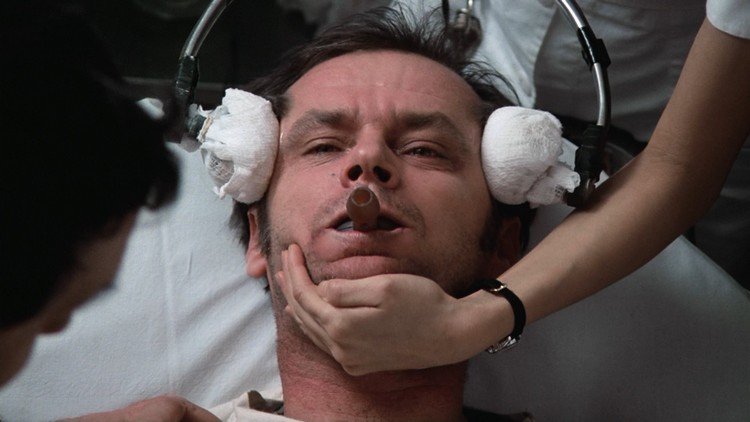
Milos Forman’s famous film One Flew Over the Cuckoo’s Nest and its striking scenes of electroshock therapy have helped create a negative image of this type of therapeutic treatment.
An undeserved reputation
Invented in Rome in 1938 by Ugo Cerletti and Lucio Bini, electroconvulsive therapy was originally called 'electroshock'. Quickly, the method became associated, in popular imagination, with violent treatment, symbolising abusive psychiatry. To the extent that the term has entered everyday language to describe a brutal, impactful event.
If convulsive seizures (similar to epileptic seizures) can be quite striking at their onset, "it was not the 'chamber of horrors' people sometimes imagine”. Technically, it is impossible to remain conscious during an electroshock: the induced seizure immediately leads to loss of consciousness,' explains Dr Swierkosz-Lenart. Since the 1940s, electroconvulsive therapy has been carried out under general anaesthesia, ensuring the patient experiences no pain.
Today, this treatment method is the subject of many scientific publications; its effectiveness is widely accepted, and it features in guidelines for managing mental disorders.