


Suicide: talking about it to save lives
Publié il y a 1 an
25.07.2025
Partager

Euphemisms such as ‘having a breakdown’ or 'ending one’s life' are often used to avoid the word suicide or out of fear of planting bad ideas in people’s heads. An unfounded and dangerous fear. “Talking about suicide does not encourage people to act; it’s quite the opposite,” says Carole Kapp, assistant doctor and head of the inpatient and emergency-crisis sector, which comprises 6 units supporting children and teenagers in distress. Breaking the silence is already a first step towards prevention. But how can we recognise the warning signs? And what should we do when we are worried about someone? Understanding is at the heart of any prevention strategy, enabling better intervention.
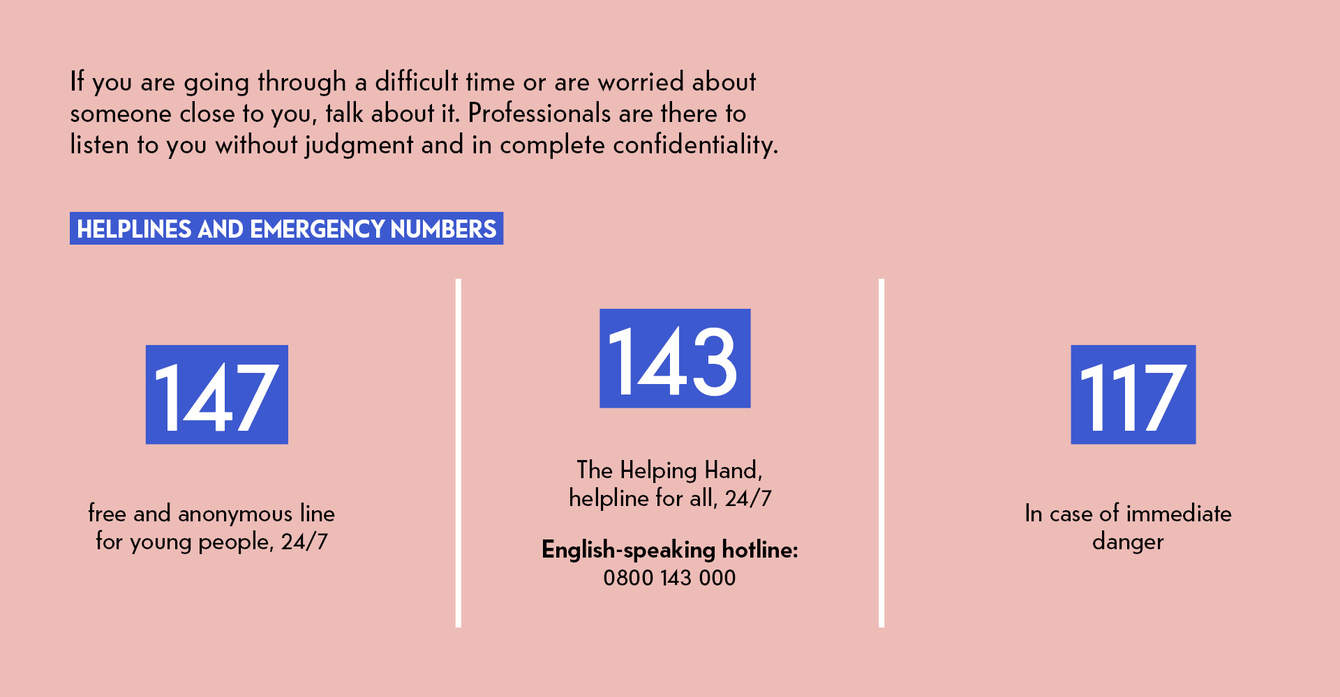
Are you having suicidal thoughts?
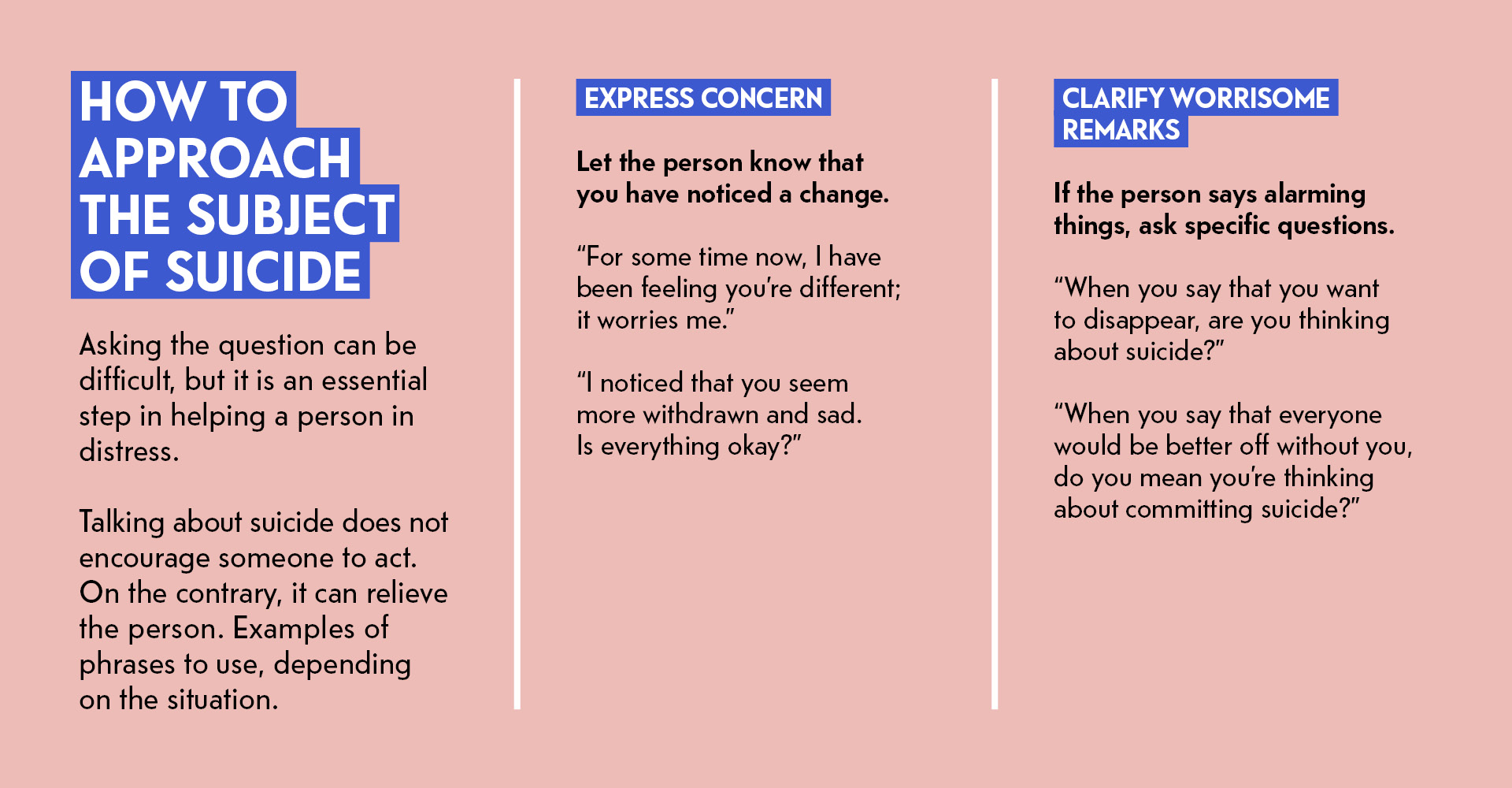
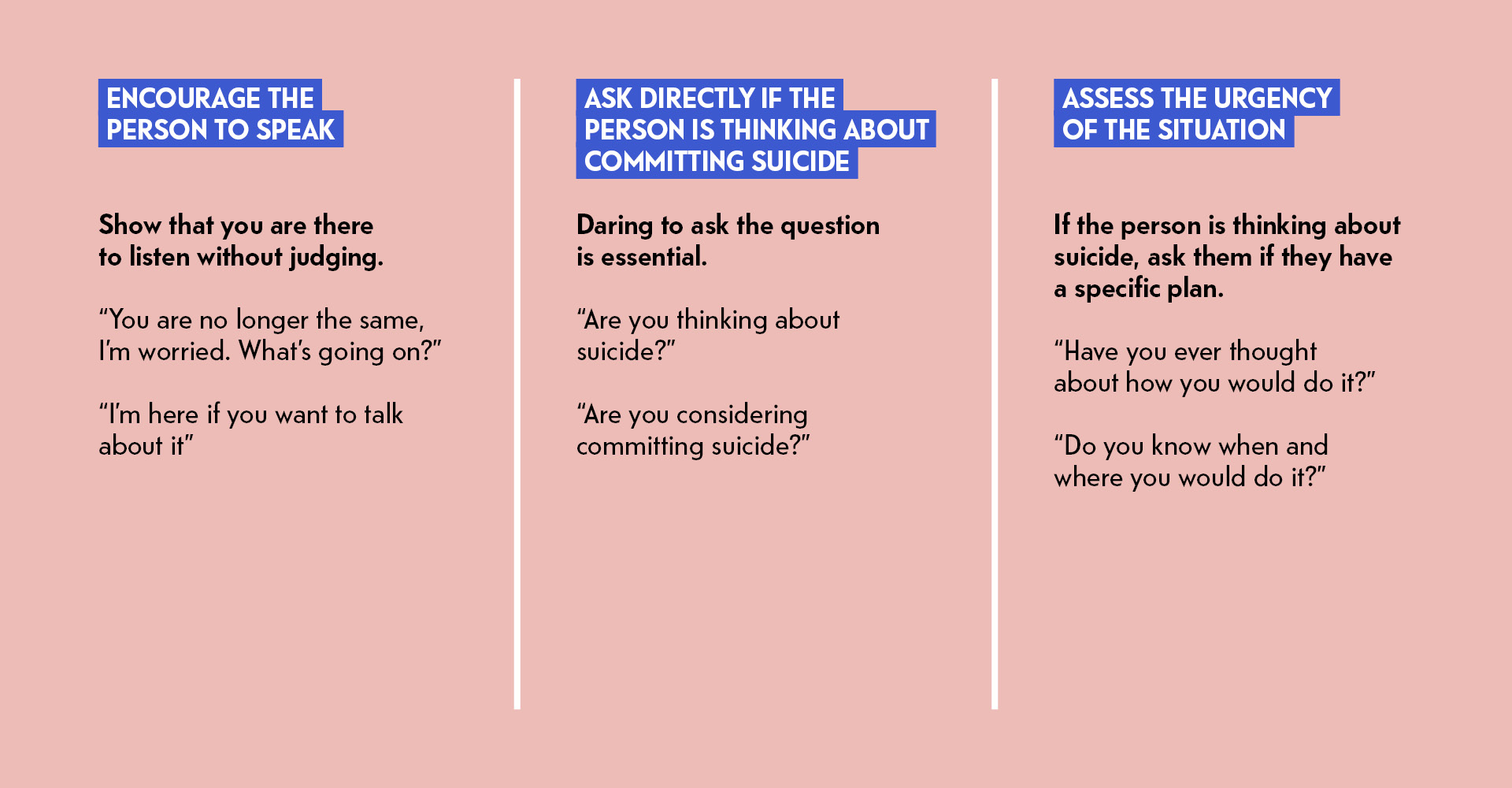
“We have to ask the question clearly: 'Are you having suicidal thoughts?' to someone who feels sad. It shows that we are there, ready to listen and help.” For the psychiatrist, we have to ban vague expressions like ‘dark thoughts', for example. They are too imprecise; they reflect a discomfort with words we don’t dare to pronounce. But naming things can help people open up.
The subject remains shrouded in prejudice and misconception, according to Carole Kapp. Suicide is often perceived ambivalently. The act is sometimes considered cowardice, sometimes courage. Yet these representations are reductive and erroneous. In reality, acting out almost never results from a fully clear-headed decision. It generally occurs in an altered state of consciousness, leaving the person in 'auto-pilot' mode, a prisoner of an extremely restricted and distorted vision of reality.
Suicide is not an isolated or sudden act. It often fits into what specialists call a 'suicidal scenario', a psychological and emotional process that builds up gradually, sometimes over several weeks, months, or even years.
Often, it is an apparently trivial element that breaks the camel’s back and precipitates the act. Once set in motion, the scenario becomes even more dangerous as it continues uninterrupted. Prevention then involves introducing concrete obstacles: making access to resources more difficult and slowing the momentum. Each barrier, however minimal, can be enough to interrupt the mechanism and give the person time to emerge from the crisis.
“We need to pay more attention to what children say”
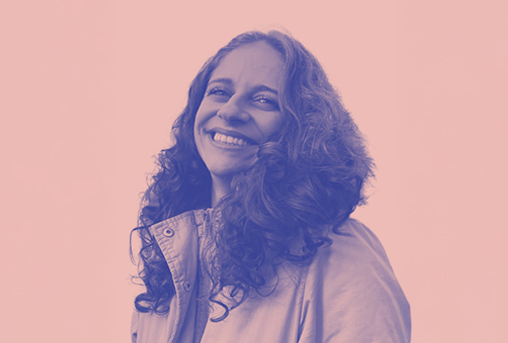
Carolina grew up in an environment where verbal violence and manipulation were omnipresent, daily, “almost normal”. This violence, both at home and outside, did not end in childhood. She mentions blows, but it was particularly psychological violence, insidious and silent, that deeply marked her. The kind that infiltrated the unspoken, the indifference of adults, and the impossibility of fleeing a home that had become toxic. “The question of whether it was normal didn’t even arise. For me, everything I lived through was normal. I didn’t identify it as ill-being.”
When she was around 11, Carolina began to think about death. Not suicide, but accidental death. For the young woman, death represented a way out of suffering, a means to regain power and end what she was going through. Because her depression did not fit the usual clichés, those around her, at school, for example, were unable to help her. “I was a clown, a smiling girl.” But behind this facade lay a dull pain that manifested differently. In adolescence, anger took over. “When I tried to talk to adults, they chalked it up to teen angst, while I was simply looking for a reaction, some form of attention. My way of asking for it was anger and violence.”
Following a conversation, her mother contacted Face à Face, an association specialising in the prevention and treatment of women and adolescents with violent behaviours. An appointment with a psychologist was arranged when she turned 18. Carolina began a course of care that provided some relief during crises. At that point, she was at high risk of acting out, and her therapist recommended hospitalisation.
Today, Carolina sees her depression as a reaction to a difficult environment. For her, as long as the root causes remain unaddressed, nothing can change. She criticises an overly passive social system. “The real solution would have been to give me the means to get away from my father, who was my tormentor.” What she lacked most was the attention, presence, and compassion of adults. She eventually found that support. Through the association, she met other young people like her. For the first time, she was no longer alone in facing her difficulties.
Social media also played an important role in her recovery. At 18, as part of her therapy, the Geneva native began sharing her story and posting videos on Instagram. Carolina found support and realised she was not alone in going through this ordeal. One of her teachers, moved by her videos, told her she had a similar experience and offered valuable support during her recovery. “You don’t have to be ultra-prepared or specialised to help someone: sometimes, a simple hug can change everything. We need to pay more attention to what children say; we need to treat them as seriously as adults.”
Carolina Gonzalez is active on social media under the name "la Carologie". She has been documenting her daily life since the age of 18 and addresses themes notably related to mental health. On YouTube, she has almost 300,000 subscribers.
What is happening on social media?
Opening up is all the more important during adolescence, a period of great psychological vulnerability. The brain is developing, emotions fluctuate, and identity is still being formed. Parents lose their status as heroes, and friends’ opinions become increasingly important.
Add to these upheavals social, school and family pressures. Above all, a factor that cannot be ignored: social media. These platforms shape young people’s daily lives. Their algorithms tend to reinforce emotionally charged content, at the risk of locking young people in anxiety-inducing loops where speeches about suicide are sometimes trivialised or even valued. “Parents must talk in real life about what is happening online,” insists the CHUV psychiatrist. “Asking a teenager about their day should not be just about school or homework.”
Stop Suicide, the association, also uses these same communication channels to encourage young people to break isolation and engage in open dialogue. "Information is the key to all prevention," insists Sophia Perez, director of Stop Suicide. Founded in 2000 following a silent march organised by students upset by the suicide of a classmate, Stop Suicide has since worked to prevent suicide among young people aged 15 to 29 in French-speaking Switzerland.
Recognising the signs to prevent more effectively
“Anyone can be concerned; everyone goes through ups and downs in life,” explains Sophia Perez, a reality borne out by numbers. According to UNICEF, one in two people reports having had suicidal thoughts at some point in their life.
One feeling comes up repeatedly among those going through a crisis: loneliness. Social isolation, loss of interest in everyday activities, or isolationism are among the most common signs. These signals, if spotted early, can alert those close to the person and help to avoid the worst.
To combat silence and prejudice, the association focuses on speaking out and prevention. It runs a range of initiatives to raise awareness among young people, including communication campaigns, school interventions, a play, and even awareness stands at festivals.
On the ground, Stop Suicide also trains professionals who work with young people to recognise signs of distress and refer them to specialists or provide them with resources.
Behind the numbers, a more nuanced reality
The rise in calls to helplines does not necessarily mean that young people are doing worse, say Stop Suicide and Carole Kapp. On the contrary, the high volume of calls also indicates a positive development. People speak out, taboos recede, and young people are better able to identify the resources to turn to in an emergency.
The number of calls to the 'Mal à ta vie' helpline from the HUG crisis unit has increased since 2019, peaking in 2021 at 2,033 calls. This does not mean young people are doing worse, according to Stop Suicide and Carole Kapp. On the contrary, this increase can be seen as a positive sign. It indicates people are opening up, the taboo is easing, and young people can better identify the resources to turn to in times of distress.
Suicide remains the leading cause of death among 15- and 29-year-olds in Switzerland, a fact that must be put into context, as this observation is also explained by the decline in other causes of death at this age, such as road accidents, points out Carole Kapp. “Significant resources have been invested in road safety for decades. If comparable efforts were made to prevent suicide, the numbers would likely drop further.”
Switzerland currently sits at the European average. Despite concerns, the data reveal a downward trend: the suicide rate has never been lower since the 1970s. An encouraging sign that also reflects a slow evolution in mentalities.
Source: STOP SUICIDE Association. To find more information: https://stopsuicide.ch/la-pour-toi/comment-aborder-le-sujet-du-suicide